
LISS INTEGRATION WITH DAYMAP
Before syncing with Daymap, we strongly recommend performing a LISS Pre-Export Compliance Check to ensure your timetable data is in the correct format.
1. Open Timetabling Solutions V10, open the Timetable Development module and open your timetable file.
- Click Publish Timetable
- Click Publish Timetable for Web Daily Organiser and click yes to save the file before publishing
- If prompted, sign in (the session timeout to publish data to the Management Portal is 10 minutes as a security control)
- Click Select, and select your Campus and Academic Year (more details)
- Click on the calendar to select a start date for this timetable. If it is for the start of the year, before the first school day, select today's date and click Publish.
2. Open the Timetabling Solutions Management Portal and go to task 6, Daily Organiser.
- If you do not have a current Daily Organiser dataset for the campus and academic year that you published a timetable to, you must create one for the LISS Integration to work, even if you do not intend to use Daily Organiser ongoing. To create a Daily Organiser dataset, open Daily Organiser, click Open, select your campus and academic year and follow the prompts (view manual)
3. Go to task 7A, SIF/LISS Integrations.
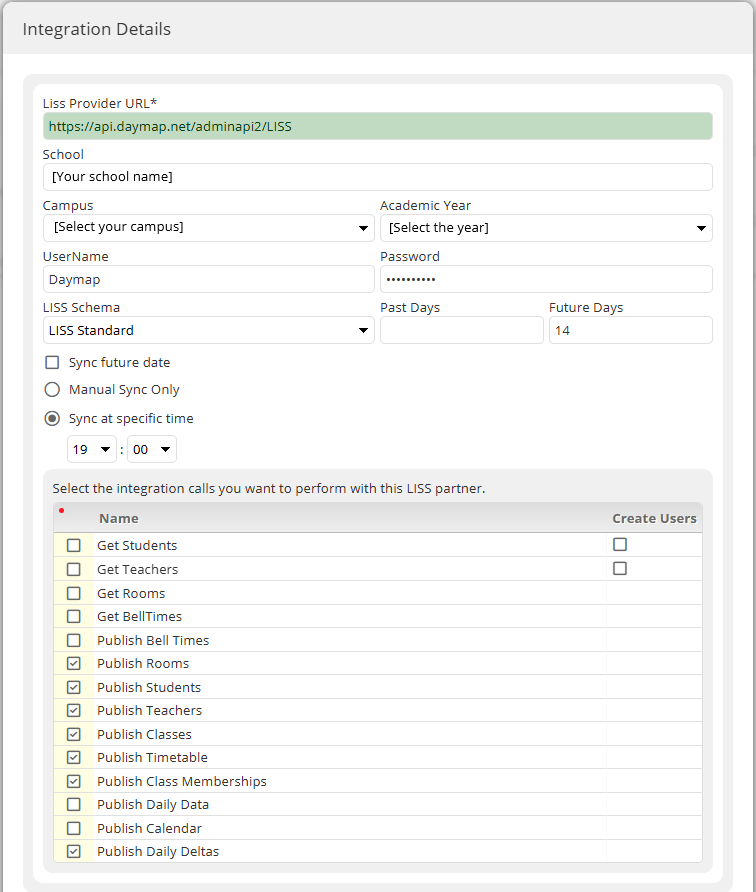
4. From the top menu, click Add and enter the details as per the image below.
- LISS Provider URL: https://api.daymap.net/adminapi2/LISS
- UserAgent: TimetablingSolutions
- School: [enter your school code] This is found in Daymap -> Settings -> Configuration -> Integration Configuration -> LISS
- Campus: Campus name as created in task 2A of the Management Portal
- Academic Year: the year containing the data you wish to sync (must have current term dates)
- UserName: Daymap
- Password: [supplied by Daymap]
- LISS Schema: LISS Standard
- Past Days: 1
- Future Days: 14
- Manual Sync: (A schedule can be created after your first successful sync)
- Tick the checkboxes as per the image below
5. Click Validate (runs a check with the credentials entered without sending data to the connected system).
6. Open Daymap and go to: Settings > Import > Timetable Import > Import Settings > Manual Timetable Import.
Daymap expects to receive six data payloads from a successful Synchronisation.
The Timetable Import page will display the times these payloads were received from Timetabling Solutions.
Generally, all six payloads should be updated simultaneously with the initiation of the synchronisation.
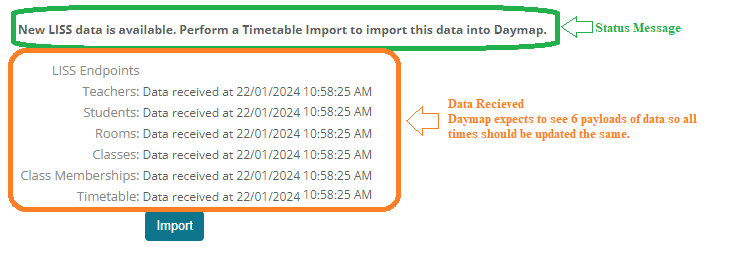
Click the Import button to start the Daymap Timetable Import.
The Status Message provides advice based on the last Timetable import and the time of the last received data, as indicated in the table below:
Timetable Status Message | Description |
New LISS data is available. Perform a Timetable Import to import this data into Daymap. | Daymap has received one or more data payloads that are newer than your last successful Daymap Timetable Import. Perform a Daymap Timetable import to apply this new data to Daymap. |
All LISS data has been successfully imported into Daymap. A Timetable Import is not required. | Daymap has not received any new data payloads since your last successful Daymap Import. Importing the timetable is likely not required and shouldn’t have any impact on the Daymap. Check the date/times received in Daymap, and make sure they line up with your expectations of performing a Synchronisation. |
LISS data has been unsuccessfully imported into Daymap. Perform a new LISS Sync and/or perform a Timetable Import again. | The last timetable import into Daymap failed, and we have not received any further data from Timetabling Solutions. |
Daily Changes
Unlike the Timetable Import process, Daily Changes are executed immediately and should be reflected in Daymap as soon as the data is received from Timetabling Solutions (on average, 3 minutes, during heavy peak times, up to 15 minutes).
View the semester two timetable in Daymap while still in semester one.
This can be achieved by following the steps in this knowledge base article:
https://timetabling.elevio.help/en/articles/942-management-portal-task-7a-sif-liss-integrations-sync-future-date
FAQ
Why is there a two-step process instead of simply synchronisation?
Daymap has decided to perform a manual timetable import that allows specific timing for updating Daymap. Generally, you do not want to perform a Daymap Timetable Import during busy times (for example, during roll marking), so this allows you to control the exact time of your import independently of the timetable.
** Update 17/12/2024: Daymap now has the capability to automatically trigger a Timetable Import after a LISS Sync has been requested. This feature is by request; please contact support@daymap.net to have it turned on for you.
The dates and times of the payloads are not updating when I perform a synchronisation.
This can indicate that Daymap cannot receive the transmitted data, that Timetabling Solutions cannot send it, or that Timetabling Solutions is unable to send it.
We recommend reviewing the logs in the Timetabling Solutions Management Portal (go to task 6 SIF/LISS Integrations | double-click your integration, then click View Logs) to see if any details are available about the LISS synchronisation. Details can then be communicated to either Daymap Support or Timetabling Solutions for review.
Can the timetable automatically synchronise with a schedule and import into Daymap?
Timetables can be scheduled to sync; it is recommended that this be done only once per day. In Daymap, data import will remain manual.
Caveat for schools migrating from the file import to LISS: Daymap can continue to use the scheduled Data Copy, which will continue to upload your Timetable File (If using V10, click File|Save to V9 Format to create the *.tdf9 file). This will trigger a Timetable import in Daymap, essentially replicating a user clicking the “Import” button in Daymap.
** Update 17/12/2024: Daymap now has the capability to automatically trigger a Timetable Import after a LISS Sync has been requested. This feature is by request; please contact support@daymap.net to have it turned on for you.
I clicked “Synchronise” in Timetabling Solutions; however, Daymap didn’t receive the data for a couple of minutes.
Possible delays may occur when receiving data, particularly during peak times. Times are logged instantaneously, so any differences in the times displayed on the Daymap Import page will be due to the delay in Timetabling Solutions sending data.
I clicked “Synchronise” in Timetabling Solutions. Daymap says it received the data; however, even after performing a Timetable import, the data is still incorrect.
Daymap can only import the data that it receives. In Timetabling Solutions, check that the correct Daily Organiser file is marked as published. To do this, open the Management Portal and go to task 6, Daily Organiser. The file being synced will have a blue globe on it. To change to a different file, simply right-click the row and select 'Mark Published'.
If the data remains incorrect, please contact Timetabling Solutions to investigate further.